
Angioplasty vs Bypass Surgery: Which Treatment Fits Your Blockage?
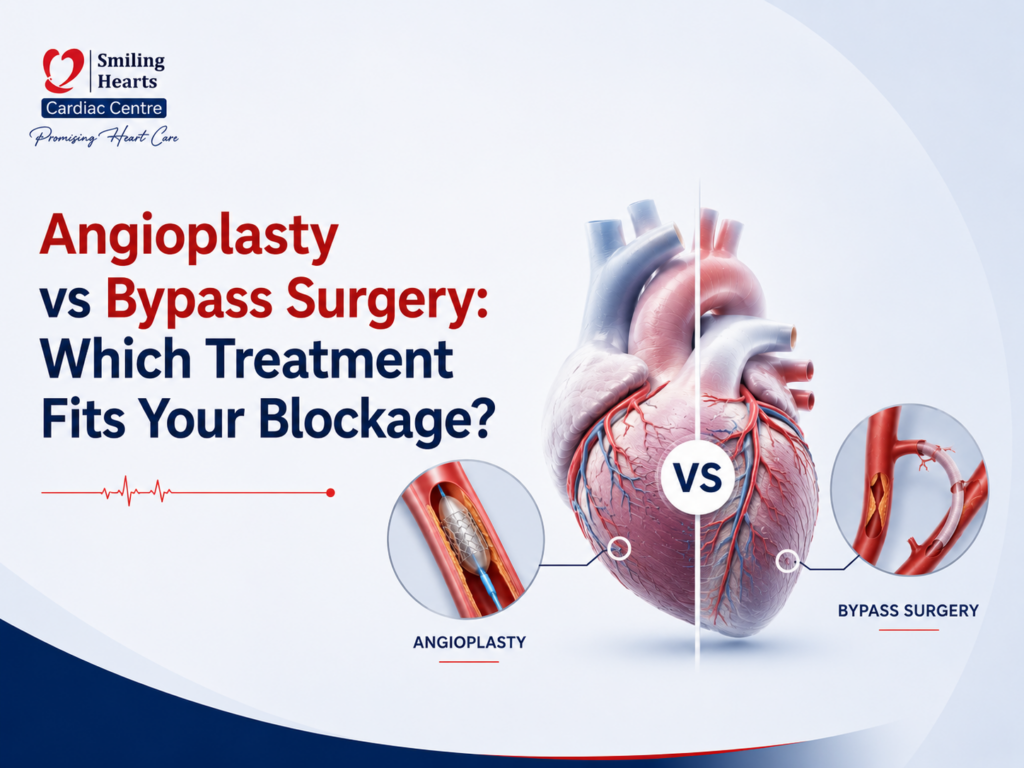
If a coronary angiogram has shown a blockage in one of your heart’s arteries, your cardiologist may have mentioned two possible treatments: angioplasty or bypass surgery. Both are designed to restore blood flow to the heart muscle, but they work in very different ways, and the right choice depends on details specific to your arteries and overall health. This guide explains how each procedure works, what actually goes into the decision, and what recovery looks like for each, so you can have a more informed conversation with your cardiologist.
This choice can come up in more than one setting. Sometimes it follows a planned angiogram done to investigate chest pain on exertion or an abnormal stress test. Other times it comes up during, or shortly after, treatment for a heart attack, when one artery is opened urgently and the remaining arteries are assessed separately once the patient has stabilised. The clinical picture in each situation is different, which is part of why the same two words, angioplasty and bypass, can lead to quite different conversations for different patients.
What Is Angioplasty?
Angioplasty, also called percutaneous coronary intervention (PCI), is a catheter-based procedure. A thin, flexible tube is guided through an artery in the wrist or groin to the site of the blockage in the heart. A small balloon at its tip is inflated to widen the narrowed segment, and in most cases a stent, a small mesh tube, is left in place to hold the artery open. The radial, or wrist, approach is now widely preferred where possible, as it tends to allow patients to sit up and move around sooner than the groin approach. Angioplasty is performed under local anaesthesia with sedation rather than general anaesthesia, and most patients go home within a day or two.
What Is Bypass Surgery?
Angioplasty, also called percutaneous coronary intervention (PCI), is a catheter-based procedure. A thin, flexible tube is guided through an artery in the wrist or groin to the site of the blockage in the heart. A small balloon at its tip is inflated to widen the narrowed segment, and in most cases a stent, a small mesh tube, is left in place to hold the artery open. The radial, or wrist, approach is now widely preferred where possible, as it tends to allow patients to sit up and move around sooner than the groin approach. Angioplasty is performed under local anaesthesia with sedation rather than general anaesthesia, and most patients go home within a day or two.
How Cardiologists Decide Between the Two
The decision isn’t about which procedure is better in general. It’s about which one fits the specific pattern of blockage a cardiologist sees on your angiogram. Factors that are usually weighed together include:
Number of blockages.
A single or limited blockage is often well suited to angioplasty; disease across multiple vessels more often favours bypass.
Location
Blockages in the left main coronary artery, which supplies a large share of the heart muscle, have traditionally leaned toward surgery, though this has shifted with newer catheter-based techniques (see below).
Complexity
Long, heavily calcified, or completely blocked segments (chronic total occlusions) can be harder to treat with a catheter alone.
Other health conditions
Diabetes, reduced heart pump function, or diffuse disease spread across the arteries can tilt a recommendation toward bypass.
Patient factors
Age, other medical conditions, and how well someone is likely to tolerate open-heart surgery all factor into the discussion.
None of these on their own settles the decision; they’re weighed together, which is why two patients with similar-sounding blockages can end up with different recommendations.
When Advanced Angioplasty Can Still Be an Option
Some blockages that would once have been sent straight to bypass surgery can now be treated with catheter-based techniques designed specifically for complex disease. Chronic total occlusion (CTO) techniques can open arteries that have been fully blocked for months or years. Left main intervention allows some left main blockages to be treated without surgery in appropriately selected patients. Rotablation and intravascular lithotripsy (IVL) break down heavily calcified plaque that a standard balloon cannot cross. Physiology-guided assessment using FFR or iFR measures whether a blockage is actually restricting blood flow enough to need treatment at all, which can sometimes avoid an unnecessary procedure altogether. None of these techniques are appropriate for every complex case, but they’re worth raising directly if bypass has been suggested and you would like to understand whether a less invasive option was considered.
Recovery and Daily Life After
Angioplasty recovery is generally quicker: many patients resume light activity within days and return to most normal routines within a couple of weeks, though this varies by individual and by how the artery was accessed. Bypass surgery involves a longer hospital stay, and recovery is measured in weeks to a few months, since the chest incision and, in many cases, the use of a heart-lung machine during surgery need time to heal. Driving, heavier lifting, and returning to physically demanding work typically take longer after bypass than after angioplasty, and your care team will usually give a personalised timeline based on your recovery. Both procedures require ongoing medication, risk-factor management such as blood pressure, cholesterol, and diabetes control, and typically a structured cardiac rehabilitation programme afterward, with follow-up visits to check how the treated artery, or graft, is functioning over time. The procedure itself is the start of treatment, not the end of it.
When to See a Cardiologist
If you’ve been diagnosed with a blockage and are unsure why one treatment was recommended over the other, it’s entirely reasonable to ask your cardiologist to walk through the specific factors in your case, or to seek a second opinion, particularly if bypass surgery has been suggested for a complex or borderline blockage. And if you’re currently experiencing chest pain, breathlessness, or other new cardiac symptoms, that’s a reason to seek medical attention promptly rather than research treatment options first.
Frequently Asked Questions
Modern drug-eluting stents have significantly reduced the chance of the treated segment re-narrowing, but angioplasty doesn’t reverse the underlying disease process elsewhere in the arteries. Ongoing medication, risk-factor control, and follow-up remain necessary regardless of which procedure is done.
Neither is universally safer. Angioplasty is less invasive and carries lower immediate procedural risk, while bypass, despite being major surgery, can offer more durable results for extensive multi-vessel disease. The more useful question is which option matches your specific blockage pattern and health profile.
Sometimes. Advances such as CTO techniques, left main intervention, rotablation, and IVL have expanded what can be treated without surgery, though not every case is suitable. This is a reasonable question to raise directly with your cardiologist, or in a second opinion.
Angioplasty typically takes well under two hours in straightforward cases, though complex blockages can take longer. Bypass surgery is a longer operation, generally several hours, reflecting its more involved surgical approach.
Yes. Both angioplasty and bypass surgery treat the blockage itself; they don’t eliminate the underlying coronary artery disease. Blood-thinning medication, cholesterol and blood pressure control, and lifestyle changes remain part of long-term care either way.
It helps to ask how many arteries are affected, where the blockages are located, why one procedure is being recommended over the other, and what recovery is likely to look like for your specific situation.
Talk to a Cardiologist
If you’ve recently been told you have a coronary blockage, whether angioplasty or bypass surgery has been suggested, Dr. Abhinit Gupta offers consultations to review your angiogram findings and discuss the treatment options suited to your specific case, including a second opinion where useful. Call 1800 208 7078 or request an appointment online.
Doctor Bio / Medical Reviewer
Dr. Abhinit Gupta is an interventional cardiologist, Associate Director – Cardiology at Regency Hospital, Kanpur, and Founder & Director of Smiling Hearts Cardiac Centre. He completed his DM in Cardiology at AIIMS, New Delhi, following MBBS from L.L.R.M. Medical College and MD in Medicine from S.N. Medical College, and trained further at Max Super Speciality Hospital, Saket, New Delhi, before joining Regency Healthcare, Kanpur, in June 2017. His clinical focus includes complex and imaging-guided angioplasty, CTO and left main intervention, structural heart disease, arrhythmia management, and heart failure treatment.
Sources
- American Heart Association / Circulation — “Angioplasty Versus Bypass Surgery for Coronary Artery Disease” (ahajournals.org)
- Manipal Hospitals Patient Education — “Angioplasty vs. Bypass Surgery: Which Is Right for You?” (manipalhospitals.com)